
Dr. Abhishek Saxena
Published on May 8, 2026
Rheumatoid Arthritis vs Osteoarthritis – Key Differences, Symptoms & Treatment
Understanding Two Very Different Forms of Arthritis
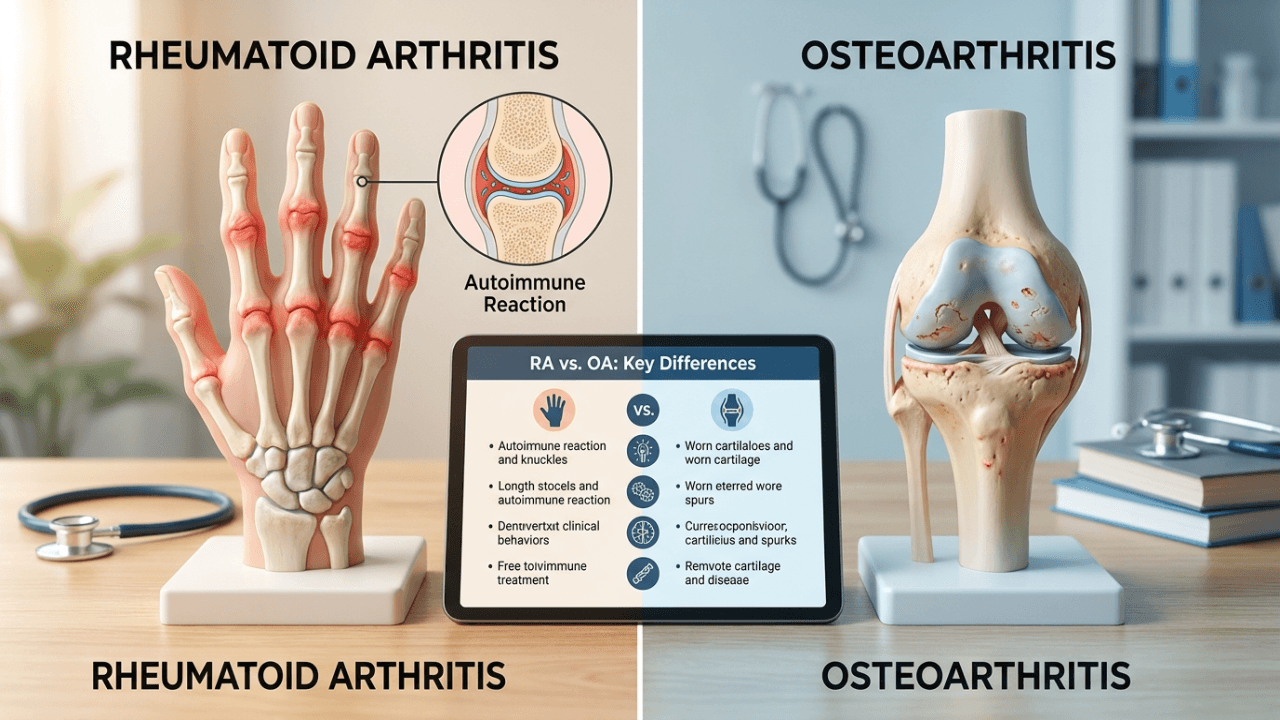
Arthritis affects millions worldwide, but not all arthritis is the same. The two most common types are osteoarthritis (OA) and rheumatoid arthritis (RA). While both cause joint pain and stiffness, their causes, symptoms, progression, and treatments are fundamentally different. Osteoarthritis is a degenerative 'wear-and-tear' condition, whereas rheumatoid arthritis is an autoimmune disease. Understanding the difference is key to getting the right diagnosis and treatment. (See also: Complete guide to arthritis types and causes)
What is Osteoarthritis (OA)?
Osteoarthritis is the most common form of arthritis. It occurs when the protective cartilage that cushions the ends of your bones wears down over time. It is a mechanical, degenerative condition often called 'wear-and-tear arthritis'. OA can damage any joint, but it most commonly affects the knees, hips, hands (especially finger joints near the nails and base of the thumb), and spine. It typically develops slowly and worsens with age. For comprehensive treatment options, read our guide on knee replacement surgery and hip replacement surgery. To learn more about general joint pain, visit: Joint pain causes and treatment options.
What is Rheumatoid Arthritis (RA)?
Rheumatoid arthritis is a chronic inflammatory autoimmune disorder. Instead of normal wear-and-tear, your immune system mistakenly attacks the synovium — the lining of the membranes that surround your joints. This leads to painful swelling, inflammation, and eventually joint erosion and deformity. RA can also affect other body systems, including the skin, eyes, lungs, heart, and blood vessels. It often affects smaller joints first, such as those in the hands and feet. Early diagnosis is critical. For more on autoimmune joint conditions, see: Autoimmune arthritis – symptoms and treatment guide.
Key Differences Between OA and RA at a Glance
- Cause: OA = Mechanical wear-and-tear. RA = Autoimmune attack on synovium.
- Age of onset: OA = Usually middle-aged or older (40+). RA = Can occur at any age, most commonly 30-60.
- Speed of onset: OA = Gradual over years. RA = Relatively rapid over weeks to months.
- Joint involvement: OA = Often affects one side of the body (asymmetric). RA = Usually symmetric (same joints on both sides).
- Typical affected joints: OA = Knees, hips, lower back, neck, finger tips (DIP joints), base of thumb. RA = Hands (MCP, PIP), wrists, feet (MTP), ankles, elbows, shoulders, and neck (cervical spine).
- Morning stiffness: OA = Less than 30 minutes, improves with movement. RA = More than 30-60 minutes (often hours), improves slowly.
- Swelling: OA = Hard, bony swelling. RA = Soft, tender, puffy swelling from inflammation.
- Systemic symptoms: OA = No (only joint symptoms). RA = Yes – fatigue, fever, weight loss, malaise, rheumatoid nodules.
- Risk factors: OA = Age, obesity, joint injury, genetics, overuse. RA = Genetics (HLA-DR4), smoking, female gender, infections.
- Blood tests: OA = Normal. RA = Elevated ESR, CRP, rheumatoid factor (RF), anti-CCP positive.
- X-ray findings: OA = Joint space narrowing, osteophytes (bone spurs), subchondral sclerosis. RA = Joint space narrowing, erosions, no osteophytes.
- Treatment focus: OA = Pain relief, physical therapy, weight loss, joint replacement. RA = Disease-modifying drugs (DMARDs), biologics to suppress immunity.
Symptom Differences – How to Tell Them Apart
Osteoarthritis Symptoms
- Pain that worsens with activity and improves with rest
- Morning stiffness lasting less than 30 minutes
- Joint pain and aching after using the joint
- Grating sensation or crackling sound (crepitus)
- Bone spurs — hard lumps around the joint
- Loss of flexibility and range of motion
- Typically no swelling unless advanced — Causes and treatment of swollen joints
Rheumatoid Arthritis Symptoms
- Pain, swelling, and warmth in multiple joints simultaneously
- Morning stiffness lasting more than 30-60 minutes (often all morning)
- Symmetrical joint involvement (both hands, both wrists, both knees)
- Fatigue, low-grade fever, loss of appetite
- Rheumatoid nodules (firm lumps under the skin, often near elbows)
- Joint deformity over time (ulnar drift, swan-neck deformity)
- Systemic effects: dry eyes, dry mouth (Sjögren's syndrome), anemia, lung inflammation
If you have persistent joint pain with morning stiffness, learn when to see a doctor: When to see an orthopedic doctor for joint pain.
How Are They Diagnosed?
Your orthopedic or rheumatology doctor will use:
- History and physical exam: Pattern of joint involvement, duration of morning stiffness, symmetry.
- Blood tests: For RA – ESR, CRP, rheumatoid factor (RF), anti-cyclic citrullinated peptide (anti-CCP) which is highly specific. OA blood tests are normal.
- Imaging: X-rays show OA changes (bone spurs, narrow space). In RA, early X-rays may be normal, but later show erosions. MRI is more sensitive for early inflammation. For more on imaging, read: X-ray, MRI, CT scan – which one for joint problems?
- Joint aspiration (arthrocentesis): Fluid analysis can distinguish inflammatory (RA) from non-inflammatory (OA) arthritis.
Treatment Approaches – Why They Differ
Osteoarthritis Treatment
Focuses on symptom management and improving joint function:
- Lifestyle changes: Weight loss reduces load on knees and hips. Low-impact exercise (swimming, walking, cycling). Read: Best exercises for joint and bone strength.
- Physical therapy: Strengthen muscles around the joint. Learn about modern knee arthroscopy and shoulder arthroscopy options.
- Medications: NSAIDs (ibuprofen, naproxen), acetaminophen, topical capsaicin.
- Injections: Corticosteroids (for flare relief), hyaluronic acid (viscosupplementation).
- Surgery: Joint replacement (hip, knee), osteotomy, or arthroscopy for select cases. See: Complete knee replacement surgery guide and hip replacement options. For shoulder issues, visit shoulder replacement.
Rheumatoid Arthritis Treatment
Focuses on suppressing the immune system to stop joint damage:
- Disease-Modifying Antirheumatic Drugs (DMARDs): Methotrexate (first-line), leflunomide, sulfasalazine, hydroxychloroquine. Start early to prevent erosions.
- Biologic agents: TNF inhibitors (etanercept, adalimumab), IL-6 inhibitors (tocilizumab), JAK inhibitors (tofacitinib).
- Corticosteroids: Prednisone for rapid inflammation control (short-term).
- Physical and occupational therapy: Maintain range of motion and hand function.
- Surgery: Synovectomy, tendon repair, or joint replacement if severe deformity. For sports-related injuries that may coexist, see sports injury management and knee injury treatment.
For natural ways to support treatment: Natural ways to relieve joint pain without medication.
Long-Term Outlook and Complications
Osteoarthritis: Slowly progressive but manageable. Many people live full, active lives with lifestyle adjustments and pain management. End-stage OA may require joint replacement — a highly successful surgery. Learn about knee replacement expectations and preparation.
Rheumatoid Arthritis: Without treatment, it leads to severe joint destruction and disability. However, modern DMARDs and biologics can induce remission and prevent damage. Early, aggressive treatment is essential. RA also increases risk of cardiovascular disease, osteoporosis, and infection. For bone health in RA patients: Osteoporosis prevention and treatment guide. Also read about how to keep bones strong after 40.
When to See an Orthopedic or Rheumatology Doctor
Consult a specialist if you experience:
- Joint pain lasting more than a few days, especially with swelling
- Morning stiffness that takes more than 30 minutes to ease
- Pain and swelling in the same joints on both sides of your body
- Unexplained fatigue, fever, or weight loss along with joint symptoms
- Difficulty performing daily activities due to joint problems
Early diagnosis of RA can prevent irreversible joint damage. For osteoarthritis, early management slows progression. If you are in or near Ajmer, meet Dr. Abhishek Saxena – best orthopedic surgeon in Ajmer. You can also book a consultation online.
Conclusion
Osteoarthritis and rheumatoid arthritis may share the symptom of joint pain, but they are entirely different diseases. OA is a degenerative condition caused by mechanical wear, typically affecting weight-bearing joints asymmetrically with mild morning stiffness. RA is an autoimmune disease causing inflammatory, symmetrical joint destruction with prolonged morning stiffness and systemic symptoms. Diagnosis relies on clinical exam, blood tests (especially anti-CCP for RA), and imaging. Treatment for OA focuses on pain relief and lifestyle changes, while RA requires aggressive immunosuppression with DMARDs. If you have persistent joint pain, swelling, or stiffness, see an orthopedic doctor or rheumatologist promptly for an accurate diagnosis. For more resources, explore our orthopedic blog or learn about common bone and joint conditions.
📞 Call: +91 86182 43967
🌐 Visit: boneandjoints.in
