
Dr. Abhishek Saxena
Published on November 15, 2026
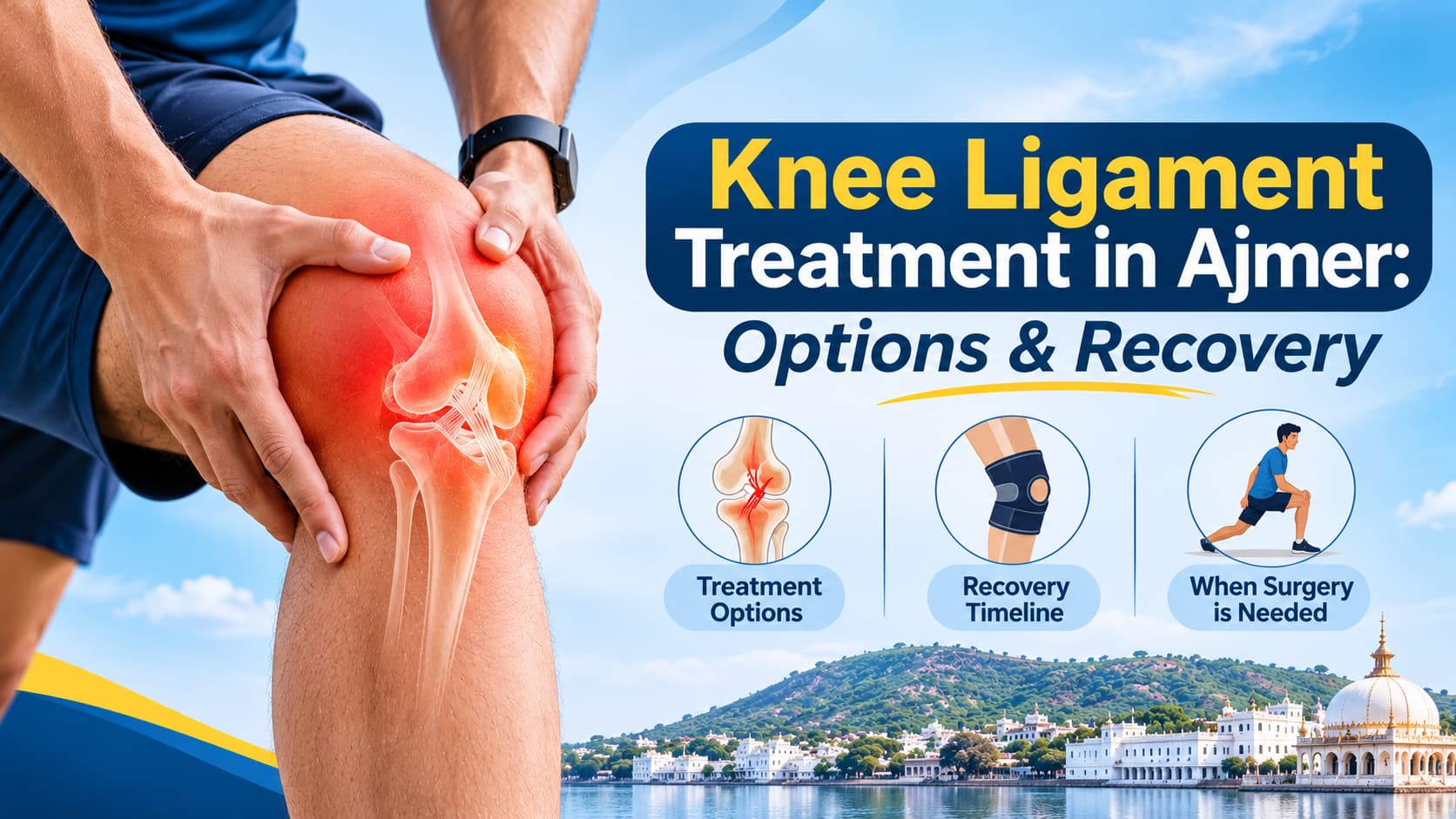
Knee Ligament Treatment in Ajmer: Options & Recovery
Knee Ligament Treatment in Ajmer: Options & Recovery
You twisted your knee playing cricket, or slipped on the stairs, and now it is swollen and feels loose when you turn. That usually means a ligament injury. Here is what knee ligament treatment in Ajmer involves, how long recovery takes, and when surgery is really needed.
What is knee ligament treatment?
Knee ligament treatment is care that restores stability to a knee after one of its four main ligaments is stretched or torn. Mild and moderate injuries are treated with rest, a brace and physiotherapy. Complete tears in active people, especially of the ACL, are often treated with arthroscopic reconstruction followed by structured rehab.
The right plan depends on which ligament is hurt, how badly, and what you need your knee to do. A 22-year-old footballer and a 55-year-old shopkeeper with the same tear may get different advice, and both can be correct.
Which knee ligament have you injured?
Your knee has four main ligaments. Each one is injured in a typical way and treated differently.
| Ligament | Where it is | Common cause | Usual treatment |
|---|---|---|---|
| ACL (anterior cruciate) | Inside the knee, centre | Sudden twist, landing badly, quick change of direction in cricket, football, kabaddi | Complete tears in active people: usually reconstruction |
| PCL (posterior cruciate) | Inside the knee, behind the ACL | Knee hitting the dashboard in a road accident, fall on a bent knee | Isolated tears: often brace and physio |
| MCL (medial collateral) | Inner side of the knee | Blow to the outer side of the knee | Most heal without surgery |
| LCL (lateral collateral) | Outer side of the knee | Blow to the inner side of the knee | Mild: non-surgical. Severe: often surgery |
Two or more ligaments can tear together. A severe MCL tear, for example, often comes with an ACL tear. That is one reason a proper examination matters more than guessing from symptoms.
Signs you should see a knee specialist
See an orthopaedic doctor soon if you notice any of these after a knee injury:
- A pop you heard or felt at the moment of injury
- Swelling within a few hours, which often means bleeding inside the joint
- The knee gives way or feels wobbly when you turn or walk on uneven ground
- You cannot put full weight on the leg
- The knee locks or catches, which can point to a meniscus tear as well
Do not wait weeks hoping it settles. A knee that keeps giving way can damage the meniscus and cartilage each time it slips.
How is a knee ligament injury diagnosed?
A knee ligament injury is diagnosed with a physical examination, then imaging if needed. The doctor gently moves your knee in specific directions to test each ligament, such as the Lachman test for the ACL. An X-ray rules out a fracture, and an MRI scan shows which ligament is torn, how badly, and whether the meniscus or cartilage is also hurt.
If your knee is very swollen, the doctor may ask you to rest, ice and brace it for a few days and examine it again. The tests are more accurate once the pain settles.
Knee ligament treatment in Ajmer without surgery
Most knee ligament injuries are treated without surgery. Non-surgical treatment works well for most MCL tears, many PCL tears, partial tears and mild sprains. It has three stages.
1. Calm the knee down (first few days)
Rest, ice for 15 to 20 minutes at a time, a compression bandage and keeping the leg raised. Your doctor may prescribe pain relief and crutches.
2. Protect it with a brace
A hinged knee brace lets the knee bend while blocking the sideways movement that strains a healing collateral ligament.
3. Rebuild strength with physiotherapy
Once pain and swelling ease, physiotherapy restores movement, then builds quadriceps, hamstring and balance control. This step decides how well the knee works long term. Skipping it is the most common reason a “healed” knee keeps giving trouble.
MCL recovery times give a good picture of what to expect without surgery:
| MCL tear grade | What it means | Typical recovery |
|---|---|---|
| Grade 1 | Mild stretch, knee stays stable | About 3 to 4 weeks |
| Grade 2 | Partial tear, some looseness | About 6 to 8 weeks |
| Grade 3 | Complete tear, knee unstable | Up to 12 weeks or longer |
Source: Mass General Brigham Sports Medicine. Your own timeline depends on age, fitness and any other injury in the knee.
When does a torn knee ligament need surgery?
Surgery is usually advised for a complete ACL tear in someone who plays sport or does physical work, for a knee that keeps giving way despite physiotherapy, and for injuries involving several ligaments or a repairable meniscus tear. A completely torn ACL does not heal back together on its own.
ACL reconstruction is done arthroscopically, through small cuts, using a camera. The surgeon replaces the torn ligament with a graft, most often a tendon taken from your own hamstring or kneecap area.
Timing matters. The American Academy of Orthopaedic Surgeons (AAOS) guideline recommends reconstruction within five months of an ACL injury to protect the knee, and prefers the patient’s own tissue over donor tissue for adults aged 18 to 35.
How long is recovery after ACL surgery?
Most people walk without crutches by about six weeks after ACL reconstruction and return to sport at nine months or later. The schedule below is a typical guide; your surgeon will adjust it for you.
| Time after surgery | What you can usually do |
|---|---|
| Days 1 to 14 | Walk with crutches and a brace, start gentle bending and quadriceps exercises |
| Around 6 weeks | Walk normally without crutches, return to desk work, start a stationary cycle |
| 3 to 4 months | Light jogging in a straight line, if strength and swelling allow |
| 6 months | Sport-specific drills, running with turns, under supervision |
| 9 months or more | Return to cricket, football or kabaddi after passing strength and hop tests |
Don’t rush the last step for a local tournament. A 2016 study in the British Journal of Sports Medicine found that the risk of re-injury fell by about half for each month that return to sport was delayed, up to nine months after surgery.
Common mistakes that slow recovery
- Calling it “just a sprain” and walking on an unstable knee for months
- Getting a fresh, swollen knee massaged hard, which can increase swelling and delay a proper diagnosis
- Stopping physiotherapy as soon as the pain goes
- Going back to sport early because the knee feels fine in daily life
What does knee ligament treatment cost in Ajmer?
The cost of knee ligament treatment in Ajmer depends on whether you need surgery and on the scans, implants, hospital stay and physiotherapy involved. Non-surgical care costs far less than reconstruction. For a clear estimate, and to check what your health insurance or government health scheme covers, ask at your consultation.
Why consult Dr. Abhishek Saxena for knee ligament treatment in Ajmer?
Dr. Abhishek Saxena is a consultant orthopaedic surgeon at Jeevan Jyoti Hospital, Ajmer, focused on arthroscopy and joint replacement. He completed his MBBS at MS Ramaiah Medical College, Bangalore, and his DNB in Orthopaedics at Tejasvini Hospital & SSCOT, Mangalore.
- Non-surgical care and arthroscopic ligament surgery under one doctor
- Treatment plans built around your goal: daily walking, work, or getting back on the field
- Guided rehab so the repair actually holds up
Frequently asked questions
Can a torn knee ligament heal without surgery?
Yes, many can. Most MCL tears and many isolated PCL tears heal with rest, a hinged brace and physiotherapy. A complete ACL tear does not grow back on its own, but some less active people manage well with physiotherapy alone if the knee does not keep giving way.
How do I know if I have torn my ACL?
Common signs are a popping sound at the moment of injury, swelling within a few hours, and a knee that feels loose or gives way when you turn. An orthopaedic examination and usually an MRI scan are needed to confirm an ACL tear.
Is ACL reconstruction a major surgery?
ACL reconstruction is usually done arthroscopically, through small cuts around the knee, using a tendon graft to replace the torn ligament. The operation is routine for orthopaedic surgeons, but full recovery takes months of physiotherapy, with return to sport usually at nine months or later.
When can I walk after knee ligament surgery?
Most patients start walking with support within the first few days after ACL reconstruction, and many walk without crutches by around six weeks. Your surgeon and physiotherapist set the exact timeline based on your graft and any meniscus repair.
Where can I get knee ligament treatment in Ajmer?
Dr. Abhishek Saxena, a DNB-qualified orthopaedic surgeon, treats knee ligament injuries as a consultant at Jeevan Jyoti Hospital, Lajpat Nagar, Ramganj, Ajmer. He offers both non-surgical care and arthroscopic ligament surgery.
