
Dr. Abhishek Saxena
Published on September 24, 2026
Robotic Vs Traditional Joint Replacement: Know The Difference
Robotic Vs Traditional Joint Replacement: Know The Difference
Joint pain has the potential to gradually limit your range of motion and interfere with day-to-day activities such as walking, climbing stairs, sitting, or standing up from a chair.
When medication, physiotherapy, and other conservative treatments fail to provide sufficient relief, joint replacement surgery may be suggested as a potential solution.
Now, you may come across information regarding robotic-assisted joint replacement and traditional joint replacement.
It is only natural to have questions regarding the difference between robotic and traditional joint replacement, and if robotic joint replacement is a better option. Furthermore, you may wonder how the orthopedic surgeon decides which technique is best for you. Let's discuss both these techniques in detail.
What Is Traditional Joint Replacement?
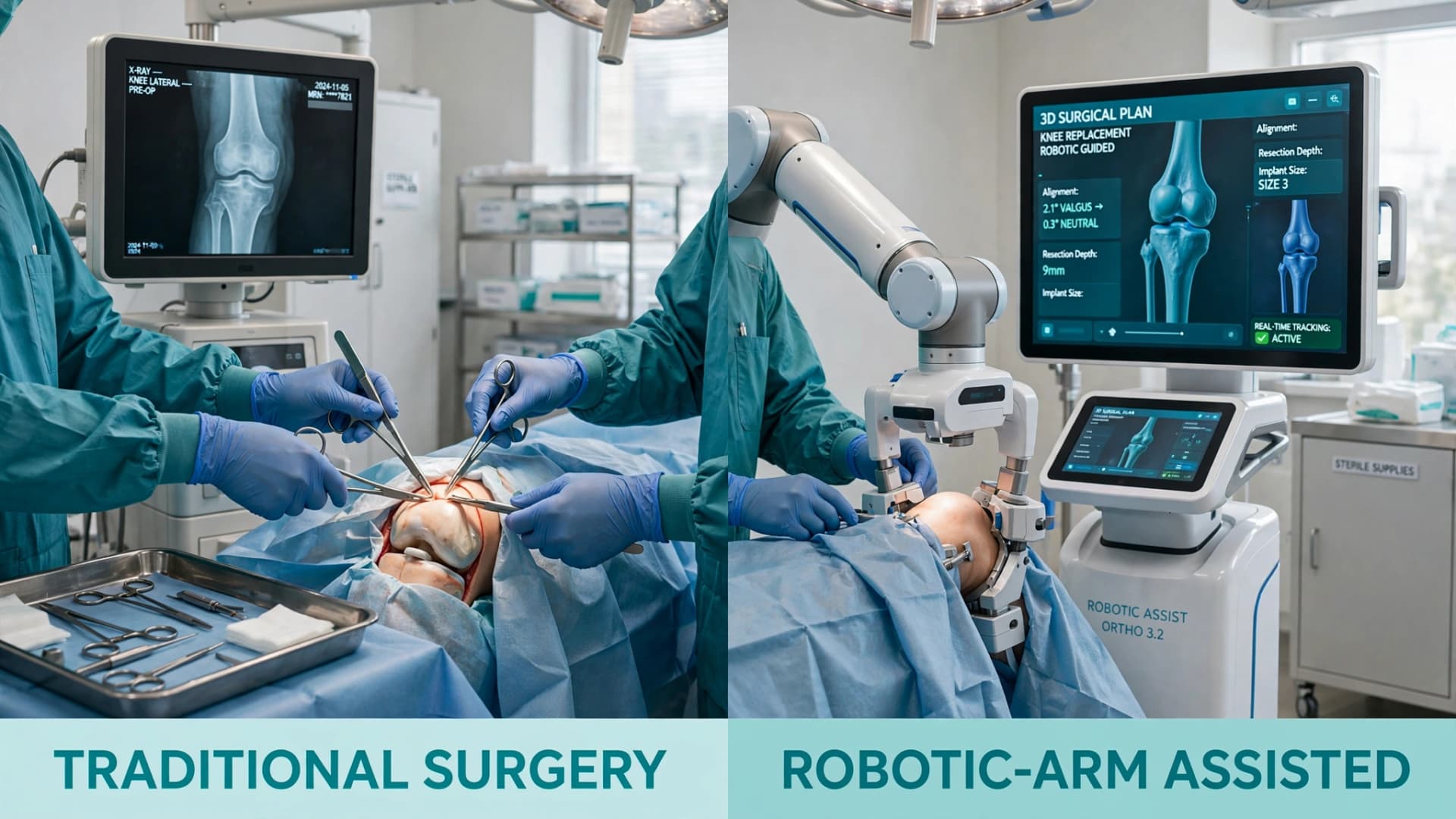
Traditional joint replacement is a surgical procedure performed through the use of X-rays, scans, surgical maps, experience, and expertise of the orthopedic surgeon.
This surgical procedure is performed for conditions such as severe knee arthritis, and other joint deformities.
The choice of surgical technique depends on individual patient needs, joint condition, and the orthopedic surgeon's expertise.
What Is Robotic-Assisted Joint Replacement?
Robotic-assisted joint replacement is a surgical procedure performed using robotic-arm assisted technologies and devices, along with the expertise of an orthopedic surgeon.
In robotic-assisted joint replacement, robotic-arm technology is used for pre-surgical planning and implant placement.
It is important to note that a robotic-assisted joint replacement is still a surgery performed by an orthopedic surgeon. The robotic-arm technology is used to assist the surgeon during the procedure.
Robotic Vs Traditional Joint Replacement
Both the surgical techniques aim to achieve the same goal – to restore function and improve the quality of life by replacing the damaged joint.
Let's compare the two surgical techniques and understand how the two techniques differ from each other.
1. Surgical Planning
The traditional surgical technique uses conventional planning in conjunction with the orthopedic surgeon's experience and expertise. Robotic-assisted joint replacement provides enhanced surgical planning and uses robotic-arm technology to assist the orthopedic surgeon during the procedure.
2. Precision And Implant Placement
Robotic-assisted technology makes it possible for the orthopedic surgeon to make accurate bone cuts and implant placement as per the pre-surgery planning. Traditional joint replacement can also ensure accurate implant position and placement using conventional surgical instruments.
3. Personalized Surgical Technique
Every patient has different joint anatomy. Robotic-assisted surgical technique provides a detailed understanding of the patient's joint anatomy. The robotic-arm technology can also be used for customized implant sizing for each patient. It is important to note that surgical technique, and implant size and position is decided by the orthopedic surgeon and not the robotic-arm technology.
4. Recovery
Patient recovers from joint replacement surgery at his or her own pace and the speed of recovery depends on various factors – age, physical condition, muscle strength, general health, recovery process, exercise regimen, and post-operative precautions. A robotic-assisted surgical technique does not ensure rapid recovery.
Is Robotic Joint Replacement A Better Option?
Robotic technology can be used for certain joint replacement procedures.
However, it is not necessary to use robotic-arm technology for every joint replacement surgery.
The choice of surgical technique and the use of robotics depends on the orthopedic surgeon and the individual patient's requirements.
When Is Joint Replacement Needed?
Joint replacement surgery may be recommended if you are experiencing severe joint pain, stiffness, or limited range of motion that interferes with your ability to perform everyday tasks.
It can be recommended for conditions such as:
- Osteoarthritis
- Severe knee pain and stiffness
- Difficulty walking or climbing stairs
- Severe joint damage
- Limited range of motion
- Decreased mobility, despite conservative treatment
- Persistent pain and stiffness
A detailed evaluation by an orthopedic surgeon is required prior to joint replacement surgery.
The orthopedic surgeon reviews your medical history, evaluates the severity of your joint pain and stiffness, and recommends the best treatment option based on your individual needs.
What To Expect Before Joint Replacement?
The orthopedic surgeon may evaluate your:
- Medical history
- Degree of joint damage
- Range of motion
- Muscle strength
- X-ray and scans
- Previous treatment
- General health and medical conditions
Depending on the results of the tests and your evaluation, the orthopedic surgeon will have a clear understanding of your condition, and will be able to recommend the best treatment.
Role Of Rehabilitation In Recovery
Surgery is just a part of the treatment. Orthopedic rehabilitation is a crucial aspect of joint replacement treatment. You are encouraged to perform the prescribed range of motion exercises and physiotherapy regimen.
Make sure you follow all the instructions and guidelines provided by your orthopedic surgeon and physical therapist.
Final Word
Both robotic-assisted and traditional joint replacement are effective treatments for joint damage and conditions such as arthritis.
Robotic-assisted technology provides advanced surgical planning and precision during the procedure, while traditional joint replacement is performed using conventional surgical techniques and instruments.
Both the surgical techniques have their advantages, and the choice of treatment depends on individual patient needs and the orthopedic surgeon's expertise. A detailed discussion with the orthopedic surgeon will help you understand your options and decide the best course of treatment.
If you are experiencing persistent knee or joint pain that impacts your quality of life, consult an orthopedic surgeon to determine your treatment options.
Frequently Asked Questions (FAQs)
1. What is robotic joint replacement?
Robotic joint replacement is a surgical procedure performed using robotic-arm technology and surgeon expertise.
2. Is robotic joint replacement performed by robots?
Robotic joint replacement is a surgery performed by an orthopedic surgeon. A robotic-arm technology is used during the procedure to assist the orthopedic surgeon.
3. Is robotic joint replacement suitable for everyone?
No, robotic joint replacement is not suitable for everyone. The choice of treatment depends on individual patient needs and the orthopedic surgeon's recommendation.
4. Is traditional joint replacement obsolete?
No, traditional joint replacement is a viable treatment option and is used routinely by orthopedic surgeons.
5. Can I expect a rapid recovery after robotic joint replacement?
Recovery after joint replacement surgery depends on various individual factors. Robotic-assisted technology does not guarantee rapid recovery.
6. Which is a better option: robotic or traditional joint replacement?
The choice of treatment depends on individual patient needs and the orthopedic surgeon's recommendation.
7. When should I see an orthopedic surgeon?
Consult an orthopedic surgeon if you are experiencing persistent joint pain, stiffness, or swelling that impacts your quality of life.
This blog is for general educational purposes only and should not replace an examination or medical advice from a qualified healthcare professional.
